

When Addiction Becomes a Weapon
How human traffickers exploit withdrawal, dependence, and the failures of our healthcare and legal systems.


According to the United Nations, the definition of human trafficking is as follows:
The recruitment, transportation, transfer, harboring or receipt of persons, by means of the threat or use of force or other forms of coercion, of abduction, of fraud, of deception, of the abuse of power or of a position of vulnerability…Exploitation shall include, at a minimum, the exploitation of the prostitution of others or other forms of sexual exploitation, forced labor or services, slavery or practices similar to slavery, servitude or the removal of organs.
National Human Trafficking Hotline: 888-373-7888 (this is who you call if you suspect someone is being trafficked).
As a primary care physician and addiction medicine specialist, I often write about the systemic factors that drive our addiction crisis. In a recent blog, I discussed the tragic interconnectedness of poverty, homelessness and addiction. However, one of the most severe, misunderstood, and overlooked dimensions our addiction crisis is the intersection of substance use disorders and human trafficking.
Many treat addiction and human trafficking as separate entities. Human trafficking is commonly thought of as a criminal justice issue, while addiction is treated as a chronic medical condition. In practice, they are deeply intertwined.
Traffickers rely heavily on the use of addiction to recruit and control victims. Conversely, the profound trauma of exploitation leaves victims vulnerable to misuse of addictive substances as a desperate but readily available coping mechanism.
We can more effectively address both crises if we understand the clinical and structural mechanisms that bind them together.
Substance Use as a Tool of Control
In the medical community, we understand addiction as a chronic brain disease. Addiction is characterized by compulsive drug seeking and use, as well as by miserable and potentially dangerous withdrawal symptoms. Traffickers exploit this biology. Rather than relying solely threats and intimidation, they frequently use a victim’s dependence on a substance, such as fentanyl, to coercion. They control access to the drug to ensure compliance.
Traffickers actively target individuals who are already vulnerable. A study published in the Anti-Trafficking Review highlighted that traffickers frequently recruit from environments where individuals are already marginalized, including directly targeting people exiting substance use detox and inpatient treatment facilities. This report states,
There were several examples of how traffickers use substances for victim exploitation and recruitment. These include using substances to ensure a victim is in a euphoric mood prior to sex work, to reward victim sex work productivity, and to initiate withdrawal effects to demonstrate the traffickers’ supreme control.
According to data compiled by the Polaris Project, which operates the National Human Trafficking Hotline, substance use concern is the top risk factor/vulnerability for sex trafficking.
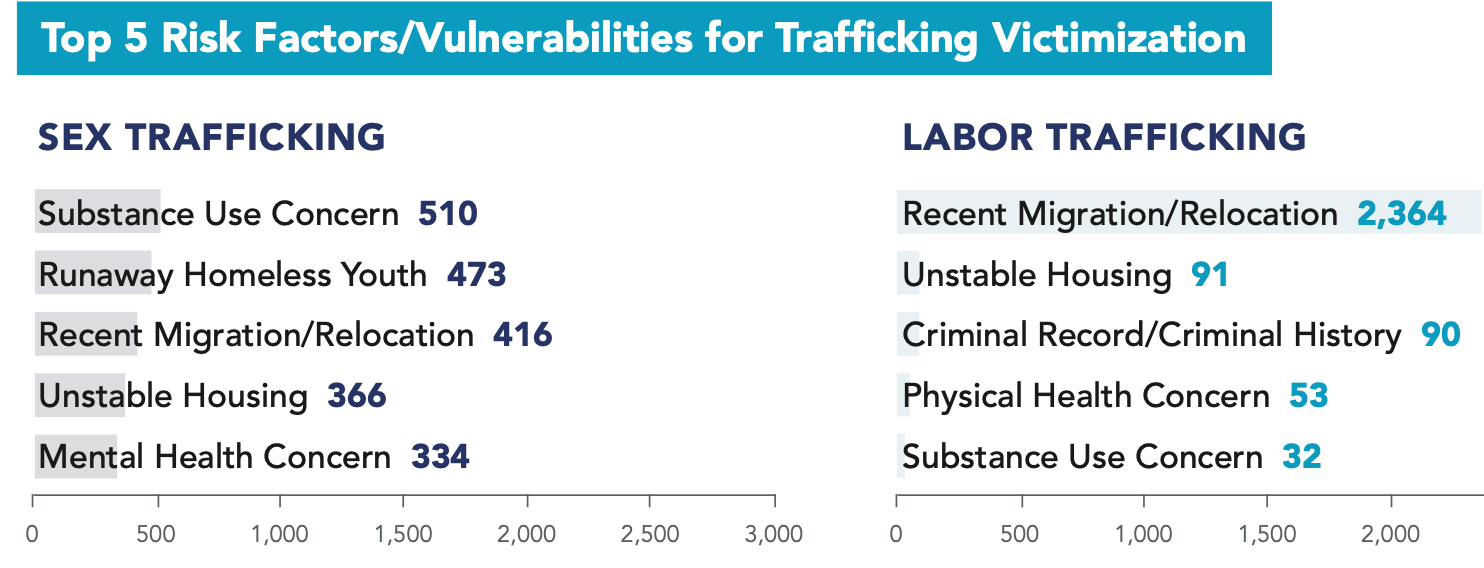
Polaris identified thousands of victims of human trafficking who had drug use induced or exploited as a primary means of control by their trafficker.
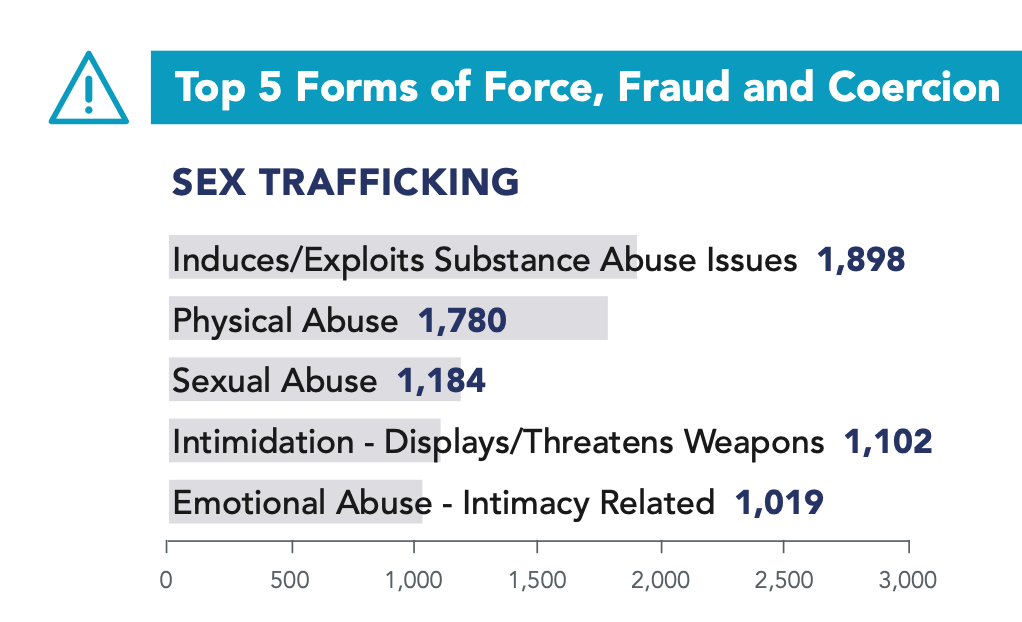
The progression of this exploitation follows a distinct, predatory pattern. Traffickers target individuals who are already vulnerable due to systemic failures, housing instability, mental health or developmental issues, or an existing substance use disorder. Once a target is identified, the trafficker either worsens an existing dependency or initiates a new one by providing free or cheap access to highly addictive substances like fentanyl or methamphetamine.
Once chemical dependency is firmly established, the dynamic shifts entirely to one of absolute control. When an individual is in active withdrawal, the physiological drive to avoid severe sickness is overwhelming. By controlling the supply of the substance, a trafficker successfully eliminates the victim’s autonomy. The individual is forced to engage in commercial sex or forced labor simply to avoid life-threatening or agonizing withdrawal symptoms. The substance becomes both a physical and a psychological barrier to escape.
Trauma and Self-Medication
The relationship also flows in the opposite direction: human trafficking is an extreme generator of trauma, which directly fuels substance use. Victims of trafficking endure chronic physical abuse, sexual trauma, and extreme psychological terror. For many, drug use can be the only immediately available mechanism to cope with the daily miserableness of their situation. The substances temporarily quiet the severe anxiety, flashbacks, and dissociation associated with ongoing exploitation. Substances often become a desperate form of self-medication to numb intolerable distress.
A survey of human trafficking survivors showed that 83.4% used substances during their trafficking exploitation.
The Healthcare System’s Blind Spot
As clinicians, we represent a critical point of intervention. Comprehensive research highlights that a significant percentage of trafficking victims encounter healthcare professionals while actively being exploited, often visiting emergency rooms, urgent care clinics, or reproductive health centers. For a variety of reasons, these cases are not identified, and the care focuses on the specific injuries, or the addiction, without recognizing the larger context of human trafficking.
Because of the heavy societal and medical stigma associated with drug use, patients presenting with severe addiction are often dismissed as difficult or uncooperative. Most doctors don’t even want to deal with addiction.
If a clinician only focuses on the immediate clinical presentation of addiction—such as an abscess, malnutrition, dental decay, or withdrawal symptoms—and fails to look for the underlying indicators of trafficking, they will treat the immediate symptom and discharge the patient directly back to their exploiter.
This creates a severe clinical gap. The clinician believes they are treating a standard case of substance use disorder, or other medical issues, while completely missing the fact that the patient is being coerced and their movements are being monitored.
The criminalization of drug possession and sex work actively prevents victims from seeking help. Victims are also forced into illegal activities related to the use and distribution of drugs, as well as prostitution, and are thus saddled with criminal charges. Traffickers frequently use the threat of law enforcement as another tool of psychological control, telling victims that they will be arrested rather than helped if they speak to authorities.

An Integrated Response
To stop perpetuating the cycle of addiction and human trafficking, our medical and legal frameworks must shift from punitive models to trauma-informed, public health-led interventions. We must implement several systemic changes.
First, we need to further expand rapid, low-barrier access to medications for opioid use disorder (MOUD), such as buprenorphine or methadone. When a patient’s addiction is successfully treated, and the withdrawal symptoms are under control, they are less susceptible to manipulation and control. We need to be able to meet people where they are and to provide care to them, regardless of their circumstances or what drugs they are addicted to, in a way that feels safe and respectful.
Second, we must institute comprehensive, mandatory training for all healthcare professionals to identify the subtle signs of human trafficking. This includes recognizing behavioral cues, such as a companion who insists on speaking for the patient and refuses to leave the room, or clinical signs, such as atypical branding tattoos or particular injuries in various stages of healing.
In a busy clinical practice, it is easy to look away, or to not ask the difficult questions, but this lets down the people who need our help the most. Clinicians also need to know how to respond to suspected cases of human trafficking.
Finally, we must support the decriminalization of substance use and survival sex work. We need to shift our focus entirely to harm reduction. When survivors do not fear incarceration, or criminal charges, they are infinitely more likely to trust healthcare providers, as well as law enforcement. This makes it easier to disclose their situation, and to accept medical treatment, counseling, and logistical support.
We cannot treat addiction in a vacuum. We cannot address it just with medications. If we are to truly confront our addiction crisis, we must recognize and address the societal issues that perpetuate this state of affairs. These include untreated mental health conditions, poverty, homelessness, limited access to healthcare, a fraying and frayed social safety net -- and human trafficking. These issues are all interrelated. The pathways out of all this misery and suffering are equally interrelated.
Very concise. "We cannot treat addiction in a vacuum"....your whole ending paragraph sums up addiction treatment. Thank you!
The US judicial system, Circuit court Drug courts programs work in concert with drug cartels primarily to ensure an endless supply of suffering bodies to capitalize off. Law enforcement arrests and traffics young addicts into endless drug court programs that ensure failure by impossible to achieve graduation standards. Any non compliance is a drug court sanction; Days in jail, or forced state slavery on road crew, while in acute withdrawal. The result of failed drug court? endless forced participation with drug courts, parole probation, sanctions, arrests, assured felony status, loss of gainful employment, a kafkaesque dive into a hell thats targetted by traffickers…homelessness, further dive into addiction to incarceratiprison systems.